
Best Salesforce Org Chart Software in 2026: 8 Tools Compared
Salesforce org charts have evolved far beyond simply showing who reports to whom. For modern sales, customer success, and strategic account teams, the best Salesforce org chart software should help teams understand organizational structure, identify decision-makers, visualize buying committees, map influence, uncover relationship gaps, and turn stakeholder intelligence into action.
There are now several approaches available, ranging from Salesforce's own Buyer Relationship Map to Salesforce-native relationship intelligence platforms and external visualization tools.
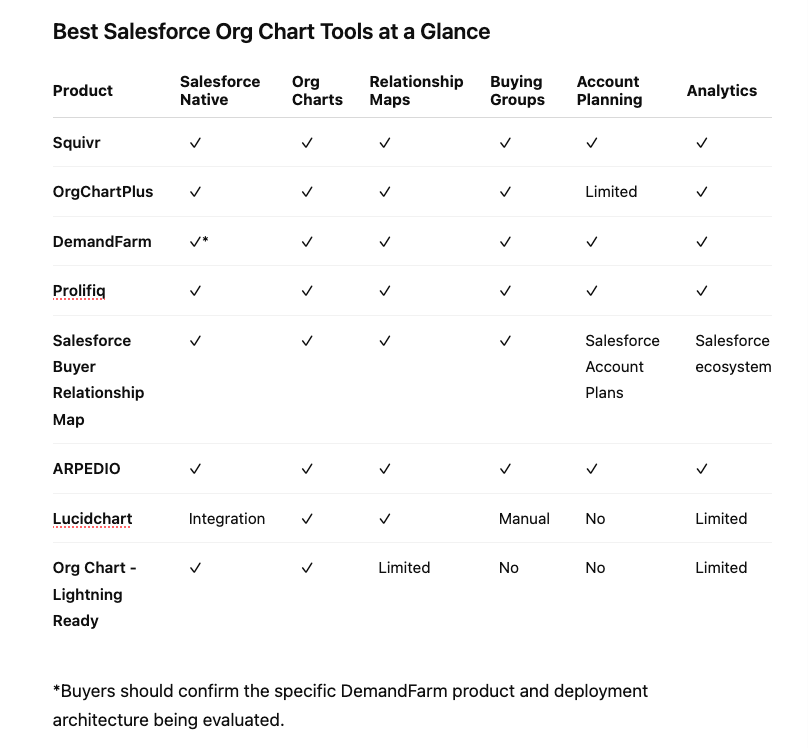
We compared eight Salesforce org chart and relationship mapping solutions based on Salesforce integration, org chart capabilities, relationship intelligence, buying group support, account planning, analytics, usability, and overall breadth of functionality.
Best Salesforce Org Chart Tools at a Glance
What should you look for?
The right solution depends on what you are actually trying to accomplish.
If your primary requirement is visualizing a hierarchy, a lightweight Salesforce org chart may be enough. Revenue teams typically need considerably more.
Modern relationship mapping should answer questions such as:
Who are the key decision-makers?
Who influences the buying process?
Where do we have strong and weak relationships?
Who are our champions, supporters, neutral stakeholders, and detractors?
Which departments and personas are missing?
How are stakeholders connected beyond their formal reporting structure?
What should the account team do next?
This is the distinction between a traditional org chart and true relationship intelligence.
1. Squivr
Best for Salesforce-Native Relationship Intelligence and Account Planning
Squivr is a Salesforce-native revenue intelligence platform that combines dynamic org charts, relationship mapping, stakeholder intelligence, buying groups, account planning, revenue planning, and analytics directly within Salesforce.
Rather than treating the org chart as a standalone diagram, Squivr connects stakeholder intelligence to the broader account and opportunity strategy.
With Squivr, teams can visualize organizational hierarchies while capturing relationship strength, sentiment, influence, buying authority, champions, blockers, indirect relationships, and stakeholder coverage.
Squivr ArcGroups extends this further by allowing teams to organize contacts into stakeholder groups and buying committees, helping revenue teams understand not only where someone sits in the organization but how they participate in a particular buying motion.
The broader Squivr platform connects this relationship intelligence with strategic account planning, action plans, playbooks, whitespace and revenue planning, scoring, reporting, dashboards, and analytics.
Squivr Strengths
100% Salesforce-native architecture
Dynamic Salesforce org charts
Account and Opportunity relationship maps
Stakeholder and buying group management
Relationship strength and sentiment
Influence and buying authority
Champions and blockers
Direct and indirect relationships
Stakeholder and persona coverage
Account planning
SWOT and competitive analysis
Strategic initiatives
Action Plans and Playbooks
Whitespace and revenue planning
Salesforce-native reporting, dashboards, scoring, and analytics
Works within the Salesforce user experience
Best For
Sales, Customer Success, RevOps, and strategic account teams that want to move beyond a standalone org chart and connect relationship intelligence with account strategy and revenue execution.
2. OrgChartPlus by SalesMethods
OrgChartPlus is one of the longest-established dedicated Salesforce org chart applications.
The Salesforce AppExchange describes OrgChartPlus as a Salesforce-native relationship mapping and org chart solution designed to visualize buying committees, identify key decision-makers, and capture stakeholder relationships.
Its functionality includes drag-and-drop org charts, automatic chart creation, configurable contact information, relationship mapping, and Salesforce reporting.
OrgChartPlus currently lists pricing starting at $30 per user per month on AppExchange.
Strengths
Salesforce-native
Mature org chart functionality
Drag-and-drop experience
Automatic org chart creation
Buying committee visualization
Relationship mapping
Configurable fields and icons
Established AppExchange presence
3. DemandFarm
DemandFarm approaches org charts as part of a broader key account management platform.
Its relationship mapping capabilities are designed to help account teams visualize complex customer organizations, understand stakeholder influence, and incorporate those relationships into strategic account planning.
DemandFarm also offers account and opportunity planning capabilities, making it relevant for larger organizations with structured strategic account management programs.
Strengths
Strong org chart visualization
Relationship mapping
Stakeholder intelligence
Account planning
Opportunity planning
AI-assisted capabilities
Designed for complex strategic accounts
4. Prolifiq
Prolifiq offers Salesforce-native relationship mapping alongside its broader account planning capabilities.
Its Relationship Map product can build maps from existing Salesforce data and allows users to visualize reporting structures, assign influence levels, identify champions and blockers, and understand stakeholder relationships.
Prolifiq also offers account planning capabilities through CRUSH, including whitespace analysis, competitive intelligence, goals, initiatives, and action plans.
Strengths
Salesforce-native
AI-assisted map creation
Account and Opportunity maps
Org chart visualization
Influence and support scoring
Champions and blockers
Stakeholder intelligence
Account planning capabilities
5. Salesforce Buyer Relationship Map
Best for Organizations Evaluating Salesforce's Built-In Capabilities First
Salesforce now provides its own Buyer Relationship Map.
The feature allows sellers to visualize contacts across company levels from Accounts and Opportunities and identify important stakeholders, champions, and potential risks.
Salesforce uses fields including Seniority Level, Department Group, and Buyer Attributes to structure the relationship map. Buyer Attributes can identify roles such as Buyer, Champion, Decision Maker, Detractor, Business User, and Executive Sponsor.
Salesforce can also use Automatic Contact Enhancements to populate certain contact information from email interactions.
This makes Salesforce itself an increasingly important option for organizations evaluating relationship mapping.
However, organizations should compare the built-in functionality against specialized applications based on how deeply they need to customize relationship structures, model relationships, manage buying groups, report on relationship intelligence, and connect stakeholder maps with their broader account planning process.
Strengths
Built directly into Salesforce
Account and Opportunity maps
Department and seniority visualization
Buyer attributes
Champion and detractor identification
Automatic Contact Enhancements
Connection with Salesforce Account Plans
Best For
Organizations that want to evaluate Salesforce's standard relationship mapping capabilities before introducing a specialized application.
6. ARPEDIO
ARPEDIO combines relationship mapping with strategic account and opportunity management.
Rather than positioning solely as an org chart application, ARPEDIO focuses on helping enterprise sales organizations implement structured account management methodologies and visualize the people involved in complex deals.
Strengths
Salesforce-native approach
Relationship mapping
Stakeholder visualization
Account planning
Opportunity management
Strategic sales methodology
7. Lucidchart
Lucidchart is fundamentally different from Salesforce-native relationship intelligence applications.
It is a general-purpose visual collaboration and diagramming platform that can be used to create organizational charts and visualize Salesforce information.
Its primary advantage is flexibility. Teams can create highly customized visualizations for many different use cases.
The tradeoff is that it is not designed specifically around Salesforce revenue workflows in the way dedicated relationship mapping platforms are.
Strengths
Flexible visualization
Familiar diagramming interface
Broad use cases beyond sales
Customizable layouts
Salesforce integration options
8. Org Chart - Lightning Ready
For organizations with straightforward requirements, lightweight AppExchange components can provide basic Salesforce org chart functionality without implementing a broader relationship intelligence platform.
Salesforce itself identifies Org Chart - Lightning Ready as an option for visualizing reporting lines directly within Salesforce.
Salesforce Org Chart vs. Relationship Mapping
One of the most important considerations when selecting a solution is whether you actually need an org chart or a relationship map.
An org chart answers:
Who reports to whom?
Relationship mapping answers:
Who matters to this account or deal, how are they connected, what influence do they have, and where do we need to build stronger relationships?
Relationship intelligence takes that another step:
What do these relationships tell us about the health of the account, and what should we do next?
For complex B2B sales organizations, that distinction can significantly change which product is the best fit.
Which Salesforce Org Chart Tool Is Best?
There isn't one answer for every organization.
Squivr stands out when the goal is to connect Salesforce-native org charts with relationship intelligence, buying groups, account planning, revenue planning, and analytics.
Salesforce Buyer Relationship Map is also worth evaluating for organizations that want to first understand how far Salesforce's standard relationship mapping capabilities can take them.
The other vendors in this comparison offer different combinations of relationship mapping, strategic account management, visualization, and Salesforce integration, and should be evaluated based on functional requirements, architecture, scalability, and total cost of ownership.
The Bottom Line
Salesforce org charts are increasingly becoming a starting point rather than the end goal.
Knowing who reports to whom is useful. Understanding who influences a purchase, who supports your solution, who can block a deal, which relationships are missing, and what actions the account team should take is considerably more valuable.
That is why the market is increasingly moving from Salesforce org charts to relationship mapping and ultimately relationship intelligence.
Squivr is designed around that progression.
Its Salesforce-native platform combines org charts and relationship maps with stakeholder intelligence, buying groups, strategic account planning, whitespace analysis, action plans, playbooks, scoring, and analytics.
For organizations evaluating Salesforce org chart software in 2026, the most important question may therefore be less about which product can draw the best chart and more about:
What can your revenue team actually do with the intelligence behind it?

Disclosure
Squivr publishes this comparison. Product capabilities can change, and each vendor approaches relationship mapping and account planning differently. We encourage buyers to independently evaluate each platform based on their requirements, Salesforce architecture, security standards, workflows, functionality, and total cost of ownership.